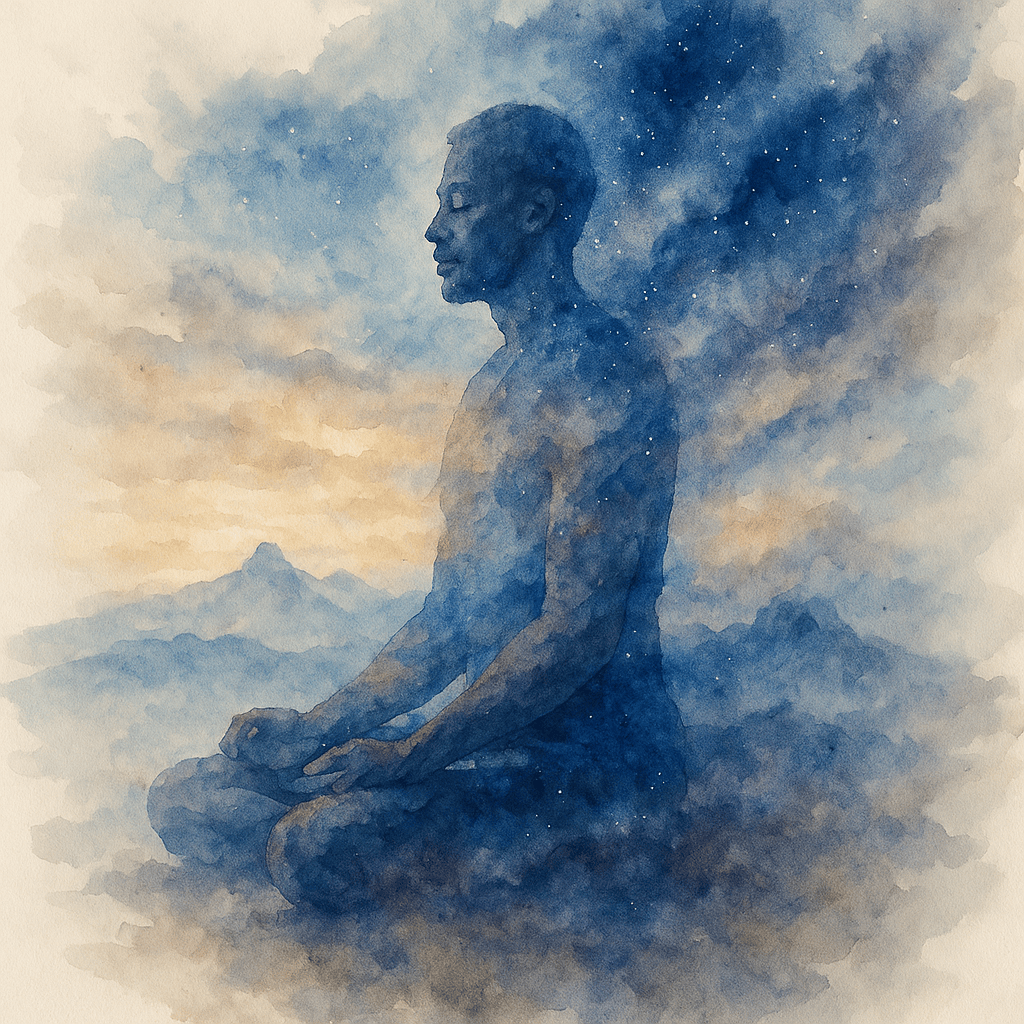
We accumulate techniques, methods, practices. We fill our minds with information, our days with rituals. Vision boards on our walls. Affirmations on our lips. Visualizations before sleep.
And yet, the life we imagine remains… imaginary.
Not because the principles are false, you understand, but because we’ve learned them backwards.
We’ve been taught to reach for something out there, to attract what we don’t have, to become worthy of receiving. We’ve learned manifestation as a method of acquisition.
But what if the ancient teachers—the mystics, the philosophers, the ones who actually lived these principles—were pointing to something far simpler, and infinitely more profound?
What if consciousness itself is the only reality, and everything else is merely its reflection?
The Nature of the Problem
Consider for a moment how you currently approach manifestation.
You want financial freedom. So you visualize abundance. You affirm wealth. You create elaborate rituals designed to attract money into your life.
But notice what’s happening in the very structure of this approach: there is you, and there is the thing you want. Subject and object. Self and other. The one who lacks and the thing that is lacking.
“This separation is the problem.”
When you’re trying to attract something, you’re inherently affirming its absence. When you’re attempting to manifest, you’re confirming that you don’t currently have it. The very act of reaching reinforces the gap you’re trying to close.
Wallace Wattles observed this over a century ago when he wrote about “thinking in the Certain Way.” He noticed that those who created wealth didn’t think about becoming wealthy—they thought from wealth. They didn’t visualize future abundance—they perceived present abundance everywhere they looked.
The difference is subtle, but total.
What the Ancient Principle Actually Says
Neville Goddard spent his life translating the esoteric teachings of Kabbalah, Christian mysticism, and ancient philosophy into practical application. His central insight was both simple and revolutionary:
Assume the feeling of the wish fulfilled.
Not as a technique. Not as a method to get something.
As a description of how consciousness works.
You see, Neville wasn’t teaching self-help. He was teaching metaphysics. He was pointing to the fundamental nature of reality itself—that consciousness is not in the world, but the world is in consciousness.
Joseph Murphy said essentially the same thing: your subconscious mind accepts as true whatever you impress upon it. Dr. Joe Dispenza demonstrates it through neuroscience: elevated emotion combined with clear intention reorganizes your brain and broadcasts a new electromagnetic signature. Charles Haanel wrote that thought is creative, and the world within determines the world without.
They’re not giving different teachings. They’re describing the same principle from different angles.
Consciousness doesn’t attract reality. Consciousness is reality, experiencing itself.
The Way We’ve Been Teaching It
Somewhere along the way, these profound insights became commodified into techniques.
“Five steps to manifest your dreams.”
Every Manifestation ‘Guru’
“The secret formula the universe doesn’t want you to know.”
“How to attract anything in 30 days or less.”
And the teachings became distorted.
People learned to do SATS—Neville’s State Akin To Sleep meditation—but they did it as a nighttime ritual to get something, then woke up and lived the rest of their day as their usual selves.
They learned affirmations, but recited them while feeling the exact opposite of what they were saying.
They learned to visualize from the end, but kept checking their current reality to see if it was “working yet.”
It’s like learning the words to a song but missing the melody entirely.
The Difference Between Knowing and Being
You can know, intellectually, that consciousness creates reality. You can study every teacher, read every book, understand every principle.
But knowing about something and being it are not the same.
When you truly assume a state—when you actually become the consciousness of the person who has what you desire—there’s no effort in it. No strain. No hoping or wishing or trying.
There’s simply the natural experience of being that person.
Imagine you already had your desire. Not in some distant future, but right now. Completely. Fully. It’s done.
How would you think about it? Probably not at all, actually. It would simply be a fact of your life, as unremarkable as the color of your eyes.
How would you feel? Not ecstatic or constantly grateful—those are the feelings of someone who just received something. You would feel the quiet, settled knowing of someone for whom this is simply normal.
This is what “living from the end” actually means.
Not peak emotional states. Not constant visualization. But the natural, relaxed consciousness of someone for whom this is already real.
Why This Requires Learning Again
You might be wondering why, if you’ve studied these teachings before, you need to learn them again.
The answer is that most of us learned them as methods to achieve goals. We learned them through the lens of Western productivity culture, where everything is a technique to get somewhere else.
But these aren’t productivity techniques. They’re descriptions of how consciousness works.
To truly understand them, we need to unlearn the framework of achievement and relearn the framework of being.
We need to stop asking “How do I get this?” and start asking “Who am I being?”
We need to recognize that we’re not using consciousness to change reality—we’re recognizing that consciousness is reality, and changing our consciousness changes everything.
The Teachers Point to the Same Moon
Throughout history, mystics and philosophers have tried to communicate this understanding.
Hermes Trismegistus wrote in the Kybalion: “The All is Mind. The Universe is Mental.”
The Upanishads declared: “Tat Tvam Asi”—Thou Art That. You are not separate from what you seek.
Jesus said, “The Kingdom of Heaven is within you,” and “It is done unto you as you believe.”
Rumi wrote: “You are what you are seeking.”
Neville Goddard synthesized all of this into practical application: assume you already are what you wish to be, and you must become it, for consciousness is the only reality.
They’re all pointing to the same truth, like fingers pointing at the moon.
The problem is, we keep studying the fingers.
A Question to Sit With
I want to offer you a question. Not to answer immediately, but to hold lightly and observe.
When you think about what you desire—whether it’s physical, materialistic, a relationship, health, creative success—notice the quality of your thinking.
Are you thinking of it, or from it?
Are you reaching toward something distant, or resting in something present?
Are you the person who wants it, or the person who has it?
Do not judge what you find. Simply notice.
Because this noticing—this gentle, honest observation of your own consciousness—is where the real work begins.
Leave a Reply